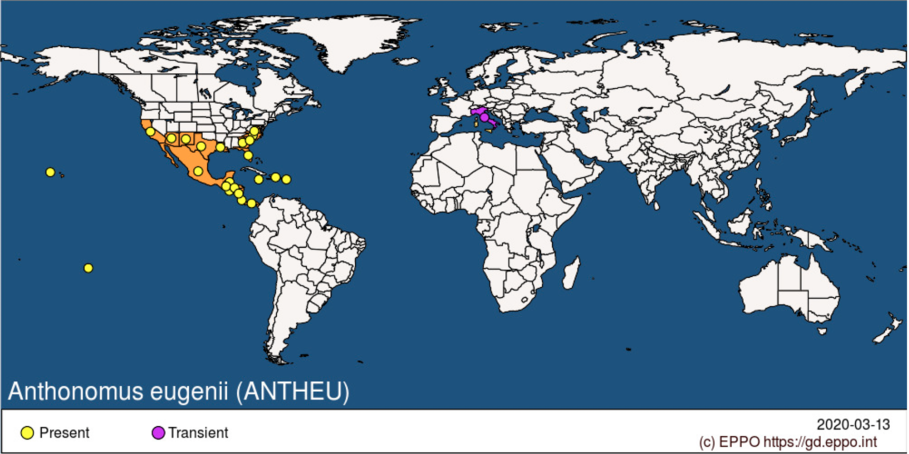
The pepper weevil is a pest native to Mexico that has spread through Central America, the southern United States and some countries in Europe. Its spread and importance have led the EU to include it in Delegated Regulation (EU) 2019/1702 as a prime concerning pest.
Morphology and biology
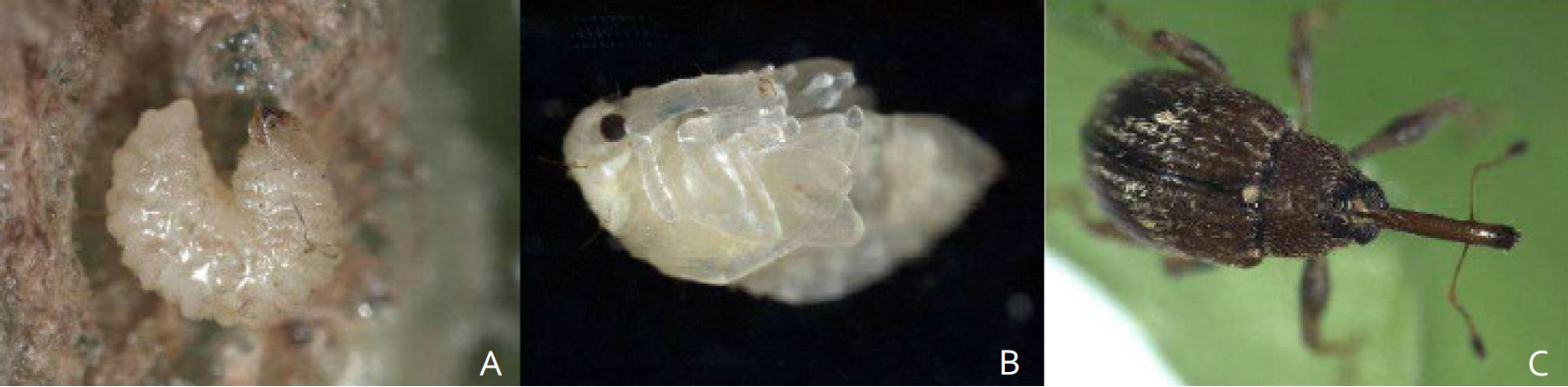
The chilli weevil has four biological stages of development: egg, larva, pupa and adult.
Stages of development of the pepper weevil in peppers: A) larva, B) pupa, and C) adult beetle. Source: Van der Gaag, D. J., & Loomans, A., 2013.
Egg: usually found in flowers, flower buds and fruits. They are generally oval-shaped, with a smooth, leathery and flexible surface, whitish in colour at first and yellowish at the end. A female chilli weevil lays an average of 340 eggs throughout the oviposition period, which hatch after 4 days.
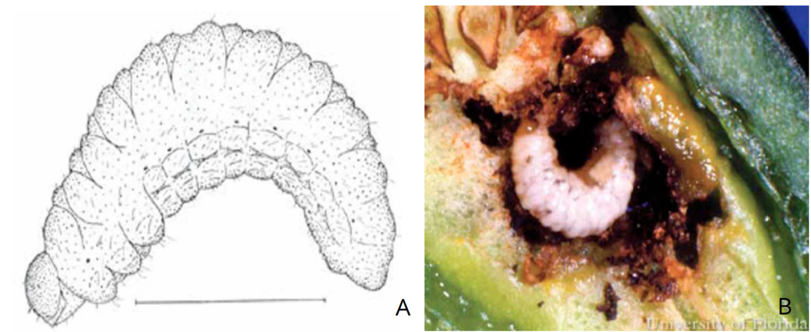
Larva: The larvae are white in colour, with large black spots and brown jaws and legless.They go through three larval stages, which, depending on the temperature, last around 7-8 days.
Larva of Anthonomus eugenii. Source: Capinera, 2002.
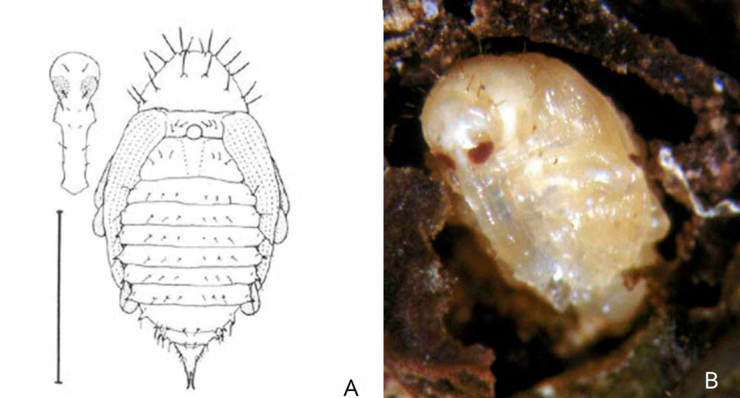
Pupa: At the beginning of its pupal process, the larva forms an oval cavity inside the fruit and then begins its transformation, during which its body shortens, widens and acquires a shiny white colour. In the first few days, the eyes are yellowish in colour and darken over time. This stage lasts between 3 and 6 days.
A)Dorsal view of the pupa. Head and face (beak) are also shown ventrally. B) Pupa of Antonomus eugenii. Source: Capinera, 2002.
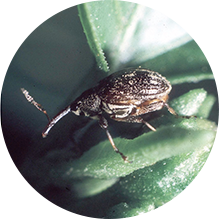
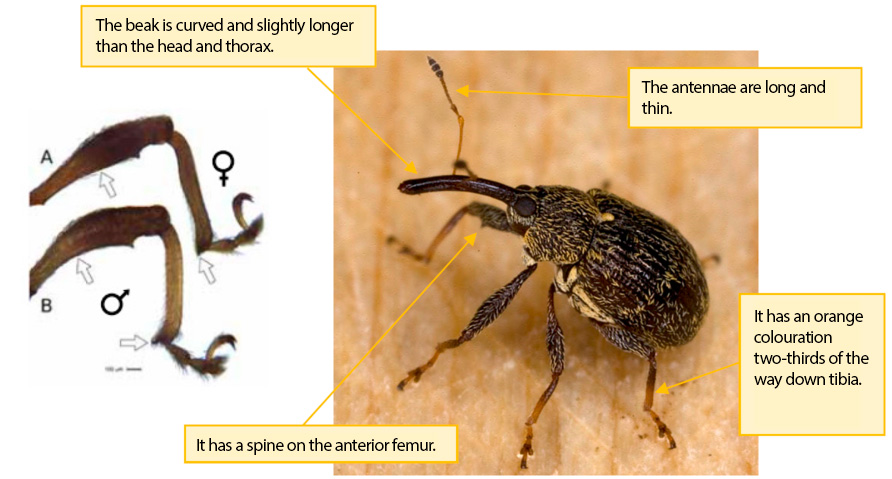
Adult: At first, adults are light brown in colour, with an oval body about 2 to 3.5 mm long, until they turngrey, reddish brown or almost black. Their main characteristic is a ‘beak’ that is longer than their head and prothorax.
Adult ofAnthonomus eugenii. Source: Torres-Ruíz, 2012; bugguide.net.
Damages
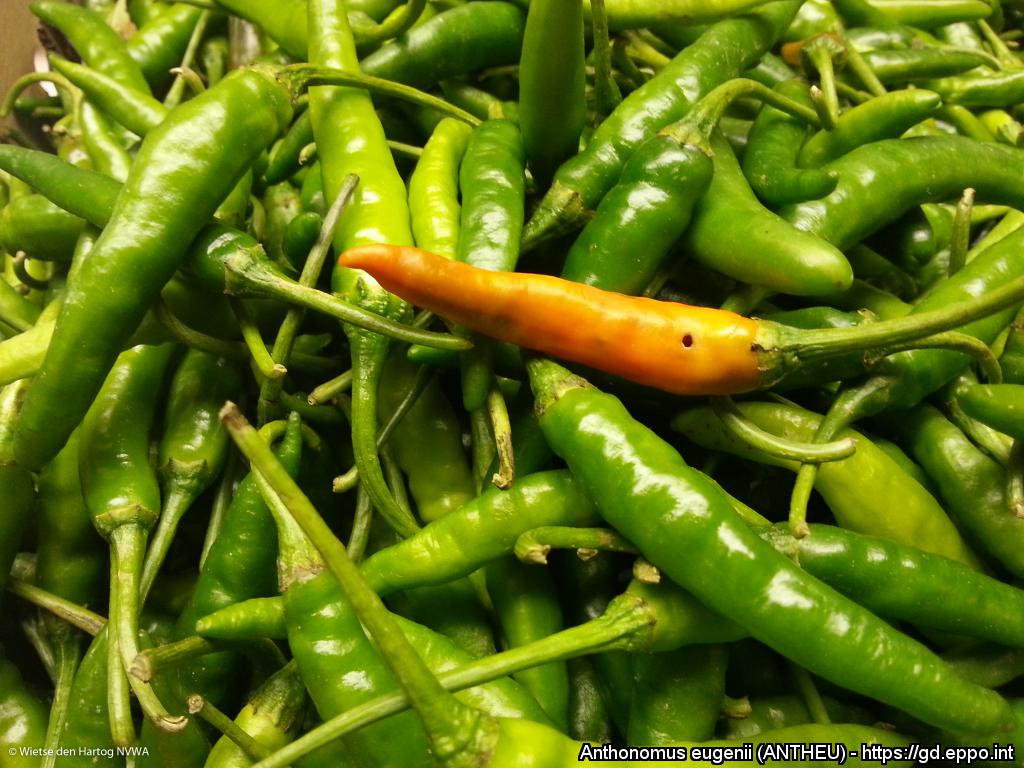
The most significant damage is caused by the larvae at the moment of hatching. They begin to feed on the fruit and tender seeds. Both the peduncle and the calyx begin to turn yellowish or reddish in colour until they wither and fall off. Infested fruits may also show deformities and a blackened colour in the seeds.
Adults feed on leaves and flower buds and during oviposition they cause damage again to the flower buds and fruits. The holes caused by oviposition also become entry points for microorganisms that cause internal infections.